


When Good Culture Makes Bad Behaviour Non‑Viable
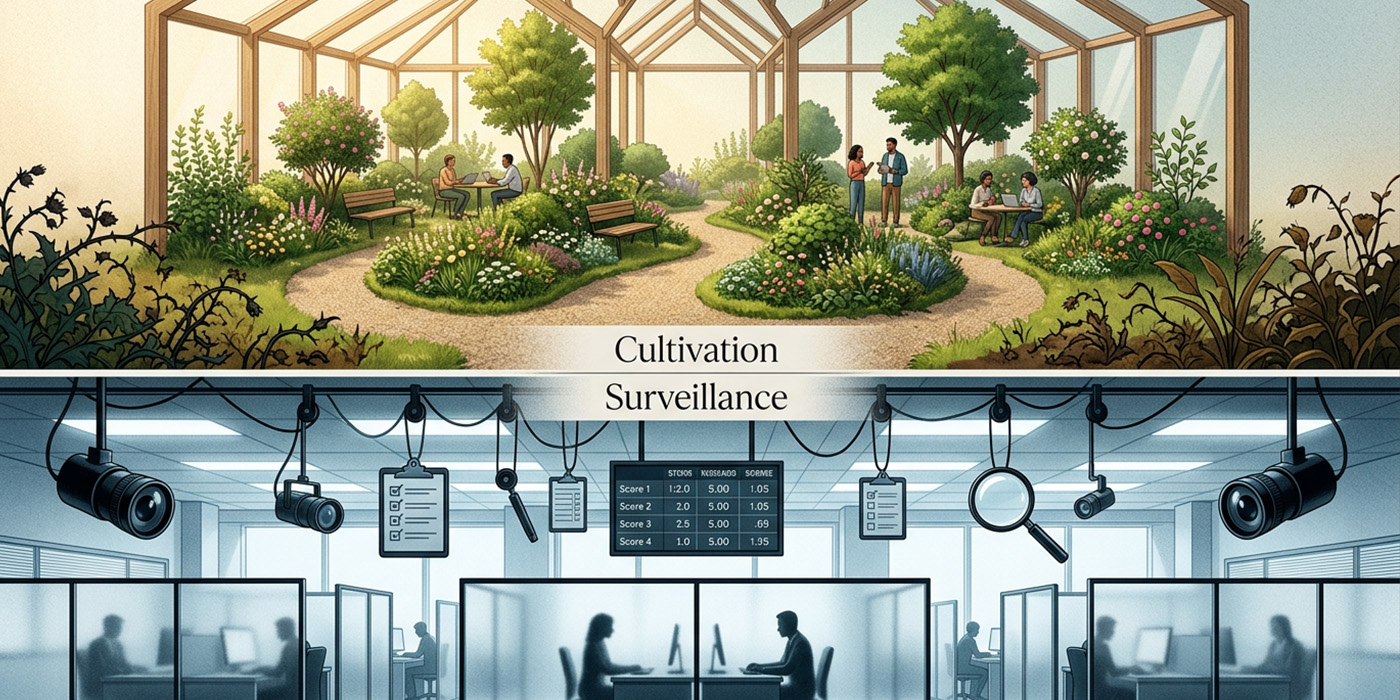
There is a quiet but important distinction between a healthy culture and a merely well‑policed one . One builds caution and performance. The other builds conditions in which better behaviour becomes easier, steadier, and more worth choosing.

A culture of detection
A well‑policed culture is obsessed with detection. It wants to know who did what, who failed when, who deserves praise, who deserves blame, and who can be trusted if watched closely enough. It builds systems of oversight, layers of evaluation, and elaborate rituals of proof. It may even call this professionalism. But more often than not, what it really creates is caution, performance, and fear.
In that kind of environment, people do not become more honest or more generous. They become more careful, more filtered, and more strategic. Trust is performed rather than extended.
A culture of reinforcement
A healthy culture works differently. It is not blind to behaviour, but it is not built around suspicion. It is built around reinforcement. It asks a more useful question: what kinds of actions become easier, more natural, and more rewarding inside this system — and what kinds become harder, lonelier, and less worth attempting?
That shift matters because behaviour is not only moral. It is ecological. People respond to incentives, norms, emotional weather, and what quietly gets them ahead. A culture teaches long before a handbook does.

Why fellowship and evaluation should not share the same layer
If we try to bake fellowship into the same layer as evaluation, we usually damage both. Fellowship cannot flourish when every interaction feels like it might be scored. People do not bond under a microscope. They adapt to it.
Good culture doesn’t punish bad behaviour—it removes the conditions that make it viable.
Evaluation becomes distorted too. Once belonging and assessment are fused together, people stop hearing feedback as support and start hearing it as a referendum on whether they are safe inside the group. That weakens candour, weakens repair, and quietly teaches self‑protection instead of mutual regard.

The real challenge is systems design
Bad behaviour often survives in organisations that officially condemn it because the stated values are not always the real values. The real values are the behaviours that remain functional. Most toxic behaviour persists not because everyone agrees with it, but because, in practice, it works. It gets attention. It avoids consequences. It secures short‑term wins. It shifts burden onto other people.
So the real challenge is not moral theatre. The challenge is systems design. What would it mean to build a workplace, a team, or a broader community where generosity worked better than sabotage? Where reliability paid better than self‑promotion? Where helping the next person created more status than making yourself look indispensable?
What weak systems tend to reward
- Ambiguity as leverage
- Image over substance
- Information hoarding
- Heroics over continuity
- Performance over trust
What healthy systems make easier
- Clear documentation
- Visible help and traceable credit
- Early problem-raising without stigma
- Clean handover and inheritable work
- Continuity over spectacle

When cooperation becomes the practical advantage
Consider the difference between a workplace that says “we value teamwork” and one in which actual advancement depends on whether work can be cleanly inherited, understood, and continued by someone else. In the first case, teamwork is an aspiration. In the second, it is built into the architecture.
If standing depends not on how loudly someone talks about collaboration but on whether the next person can pick up the work without drama, then hoarding information becomes a liability. Obscurity becomes weakness. Gatekeeping becomes self‑sabotage. The culture has not merely preached cooperation. It has made cooperation materially wiser.
Kindness needs design
The most humane cultures are not merely warm. They are structurally intelligent. They do not confuse kindness with softness. They understand that kindness without design is fragile. If you want a culture of trust, then people must be able to rely on something more durable than good intentions. They must be able to rely on norms, systems, and shared expectations that protect trust from erosion.
That is why the strongest culture is not one that is best at catching bad behaviour after the fact. It is one that makes better behaviour the more rational choice in the first place.
Questions worth asking
- What kind of soil are we creating here?
- What grows naturally in this place?
- What withers?
- What gets easier every month we keep doing things this way?
- What have we accidentally made viable?
